
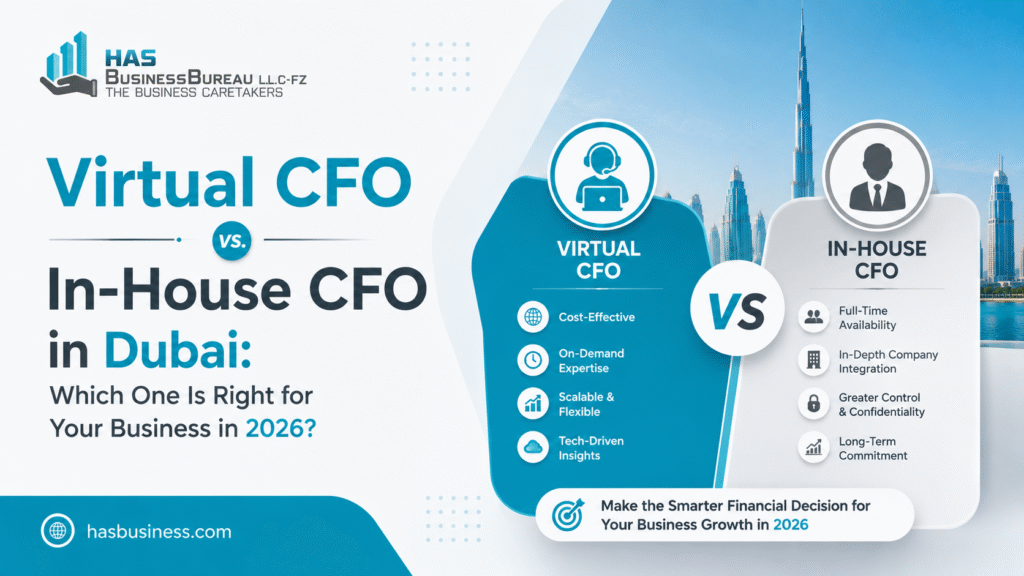
Introduction: The Finance Leadership Question Every Growing Dubai Business Faces
There comes a point in every growing Dubai business when a spreadsheet is no longer a strategy. When your accountant can handle the numbers but cannot tell you why your cash flow is tight despite strong sales. When your bank is asking for a financial model and you don’t have one. When UAE Corporate Tax, VAT, transfer pricing, and investor reporting have all become simultaneous priorities — and nobody in the room is qualified to lead them all.
That point is when you need a Chief Financial Officer.
But the question that follows is rarely straightforward: do you hire a full-time CFO on your payroll — with a salary, benefits, visa, gratuity, and recruitment fee — or do you engage Virtual CFO services in Dubai from a specialist provider who brings equivalent expertise at a fraction of the cost?
In 2026, this is one of the most consequential decisions a Dubai SME can make. Get it right and you have a financial leader who accelerates growth, protects profitability, and keeps you compliant in an increasingly demanding regulatory environment. Get it wrong and you either overpay massively for talent you don’t yet need — or you underfund the function entirely and pay the price in missed opportunities, tax penalties, and banking rejections.
This guide from HAS Business Bureau — providers of Virtual CFO Services in Dubai — gives you an honest, data-driven comparison of both models so you can make the right call for your specific business.
First: What Does a CFO Actually Do?
Before comparing models, it’s worth being precise about the role. A Chief Financial Officer is responsible for:
- Financial strategy — translating business goals into financial plans, capital structures, and investment priorities
- Management reporting — producing the financial information leadership needs to make decisions
- Budgeting and forecasting — building annual budgets, rolling forecasts, and scenario models
- Cash flow management — ensuring the business never runs out of working capital
- Tax planning and compliance — in the UAE context, this means VAT, Corporate Tax, transfer pricing, ESR, AML, and UBO obligations
- Banking and investor relations — managing lender relationships and preparing for fundraising
- Internal controls and governance — protecting the business from fraud and error
- Risk management — identifying and mitigating financial and operational risks
A bookkeeper records what happened. An accountant reports what happened. A CFO interprets what happened, explains why it happened, and decides what to do next.
This distinction matters enormously when choosing between a Virtual CFO and a full-time hire — because both models deliver the same function, but at radically different costs and with meaningfully different advantages.
The True Cost of an In-House CFO in Dubai (2026)
Most business owners think about base salary when they consider hiring a CFO. The reality is significantly more expensive.
Base Salary
According to data from multiple recruitment and salary-benchmarking platforms for 2024 and 2025, the average salary for an experienced CFO in Dubai ranges from AED 400,000 to over AED 900,000 per year, depending on experience and the size of the company. For large enterprises, this figure can exceed AED 1.5 million. For a typical Dubai SME hiring its first qualified CFO, a realistic annual base salary expectation is AED 450,000 to AED 600,000.
Total Employment Cost: The Full Picture
| Cost Component | Estimated Annual Cost (AED) |
|---|---|
| Base salary | 450,000 – 600,000 |
| Performance bonus (20–30% of base) | 90,000 – 180,000 |
| Health insurance (executive + family) | 20,000 – 40,000 |
| Annual gratuity provision (21 days/year) | 25,000 – 35,000 |
| Visa and Emirates ID | 5,000 – 8,000 |
| Recruitment fee (15–25% of annual salary) | 67,500 – 150,000 (one-off) |
| Housing/transport allowance | 60,000 – 120,000 |
| Training and professional development | 10,000 – 20,000 |
| Total Year 1 Cost | 727,500 – 1,153,000+ |
In the high-inflation labour market of 2026, the cost of an experienced CFO in the UAE, including visa costs, housing allowances, and performance bonuses, can easily exceed half a million dirhams annually — and that figure does not include the significant one-time recruitment cost or the risk of a mis-hire.
Executive-level mis-hires typically cost 1.5x to 3x the annual salary when you factor in lost productivity, business impact, and the cost of re-hiring. For a CFO at AED 600,000, a failed hire costs between AED 900,000 and AED 1.8 million in total.
The Hidden Costs Nobody Talks About
Beyond the direct compensation package, there are invisible costs to an in-house hire:
Time to productivity — A new CFO joining your business typically takes 60 to 90 days to become fully effective. They need to understand the business, the systems, the banking relationships, the team, and the regulatory history. During that period, you are paying full salary for partial output.
Key-person dependency — When your CFO leaves (and in Dubai’s competitive market, they will eventually), the financial function leaves with them. You face disruption to reporting, banking relationships, ongoing tax matters, and investor communications at precisely the wrong moment.
Support requirements — A CFO cannot function without a supporting team. They need at least one financial analyst or management accountant, which adds another AED 120,000 to AED 180,000 to your annual cost.
Technology and systems — An in-house CFO will typically want ERP upgrades, financial modelling tools, and reporting software. Budget an additional AED 30,000 to AED 80,000 per year.
The True Cost of Virtual CFO Services in Dubai (2026)
The monthly cost for a high-quality Virtual CFO service in Dubai can range from AED 5,000 for basic strategic oversight to AED 25,000 or more for a more intensive, hands-on engagement. Even at the high end, the annual cost is a fraction of a full-time hire.
A realistic cost model for HAS Business Bureau’s Virtual CFO Services:
| Engagement Level | Monthly Retainer (AED) | Annual Cost (AED) |
|---|---|---|
| Foundation (reporting + VAT oversight + basic cash flow) | 5,000 – 8,000 | 60,000 – 96,000 |
| Growth (full reporting + CT + budgeting + bank liaison) | 8,000 – 15,000 | 96,000 – 180,000 |
| Strategic (Growth + investor relations + M&A + board reporting) | 15,000 – 25,000 | 180,000 – 300,000 |
For a UAE SME with annual revenues between AED 5 million and AED 50 million, outsourced CFO services typically deliver 60 to 75% cost savings versus an in-house hire — with access to a broader range of expertise, no employment liability, and no key-person risk.
The cost savings are not the only financial benefit. A Virtual CFO retainer is a fully deductible business expense for UAE Corporate Tax purposes. There is no gratuity provision, no recruitment risk, no visa cost, and no notice period.
Capability Comparison: Virtual CFO vs. In-House CFO
Financial Strategy and Planning
Both models deliver annual budgeting, forecasting, scenario modelling, and strategic financial advice. The key difference: a Virtual CFO from a specialist provider brings cross-industry experience — having worked across multiple sectors, business models, and growth stages. An in-house CFO brings deeper knowledge of a single business, which is valuable at enterprise scale but less relevant for an SME where the CFO’s breadth of experience matters more than depth in one company.
UAE Tax Compliance: VAT, Corporate Tax, AML, UBO, ESR
This is where the Virtual CFO model has a structural advantage in 2026. UAE tax and compliance regulations — Corporate Tax, VAT, AML, UBO, ESR — are evolving rapidly and require dedicated specialist knowledge to navigate correctly.
A Virtual CFO acts as a fractional expert who can navigate the complexities of Federal Tax Authority audits, optimise tax-efficient structures, and manage cross-border transfer pricing without requiring a permanent seat at the boardroom table.
At HAS Business Bureau, the Virtual CFO works alongside our in-house tax consultancy team — meaning you get not just a CFO, but a full bench of specialists in VAT, Corporate Tax, AML, UBO, and ESR. No single in-house hire can match this breadth.
For a complete breakdown of UAE Corporate Tax obligations, read our guide: UAE Corporate Tax 2026: What Every Business Owner Must Know Before Filing.
Technology and Real-Time Reporting
Technological integration in 2026 has further tilted the scales in favour of the virtual model. With the upcoming national e-invoicing pilot and the widespread adoption of AI-driven reconciliation, the need for a physical presence to oversee books has largely evaporated. A Virtual CFO can monitor a company’s financial health score from anywhere, providing proactive alerts on liquidity buffers or potential tax liabilities before they become crisis points.
Cloud-based platforms — Zoho Books, Xero, QuickBooks, and emerging AI-powered tools — mean that a Virtual CFO has the same real-time visibility into your numbers as an in-house hire sitting in your office. The physical presence argument has largely been eliminated by technology.
Banking and Investor Relations
Both models can manage banking relationships and prepare investor documentation. However, a Virtual CFO from an established firm brings pre-existing relationships with UAE banks that a newly hired individual CFO cannot replicate. HAS Business Bureau’s team has direct connections with Emirates NBD, Mashreq, RAKBANK, and First Abu Dhabi Bank — which accelerates facility applications and account opening.
Availability and Responsiveness
This is the most legitimate advantage of the in-house model. A full-time CFO is physically present in your business and available throughout the working day. A Virtual CFO is available during agreed engagement hours and scheduled meetings — which covers the vast majority of the CFO function, but may not suit businesses where finance leadership needs to be continuously on-site.
For businesses with complex operations, high transaction volumes, or where the CFO’s presence in daily management is genuinely critical, a full-time hire may be appropriate. For everyone else, a Virtual CFO is superior.
Side-by-Side Comparison: Every Dimension That Matters
| Dimension | In-House CFO | Virtual CFO (HAS Business Bureau) |
|---|---|---|
| Annual Cost | AED 727,500 – AED 1,153,000+ | AED 60,000 – AED 300,000 |
| UAE CT & VAT expertise | Depends on hire | ✅ Included + specialist team |
| AML/UBO/ESR compliance | Depends on hire | ✅ Included |
| Cross-industry experience | Single business | ✅ Multiple sectors |
| Scalability | Fixed cost | ✅ Scale up/down |
| Recruitment risk | High (mis-hire cost up to AED 1.8M) | ✅ Zero |
| Gratuity liability | Yes (ongoing provision) | ✅ None |
| Key-person dependency | High | ✅ Team-based delivery |
| Time to productivity | 60–90 days | ✅ 1–2 weeks |
| Physical presence | ✅ Daily | As required (meetings, reviews) |
| Banking relationships | Individual | ✅ Institutional |
| Board/investor reporting | ✅ Yes | ✅ Yes |
Who Should Choose Each Model?
Choose an In-House CFO If:
- Your business generates AED 100 million or more in annual revenue
- You have a complex, multi-entity structure that requires a dedicated full-time financial leader
- You are preparing for an IPO or institutional investment round where a named CFO is an investor requirement
- Your operations require daily, on-site finance leadership involvement
- You already have a finance team that needs a full-time head
Choose Virtual CFO Services in Dubai If:
- Your business generates AED 2 million to AED 50 million in annual revenue
- You need CFO-level expertise but cannot justify the full-time cost
- You are navigating UAE Corporate Tax and VAT compliance and need specialist oversight
- You are raising finance, restructuring, or preparing for a business sale
- You are a free zone entity managing Qualifying Free Zone Person status for 0% CT (see our business setup guide)
- You want the flexibility to scale the engagement up or down as your needs change
Practical Scenarios: The Right Choice for Different Dubai Business Profiles
Profile 1: E-commerce startup, AED 4M revenue, 1 year old Needs: VAT returns, CT registration, cash flow forecasting, bank account facilitation. Right choice: Virtual CFO (Foundation tier). Estimated annual cost: AED 72,000 vs AED 800,000+ for an in-house hire.
Profile 2: Management consultancy, AED 15M revenue, 5 years old Needs: Monthly management accounts, CT compliance, budgeting, banking relationships, potential investor deck. Right choice: Virtual CFO (Growth tier). Estimated annual cost: AED 144,000 vs AED 900,000+ for a qualified in-house hire.
Profile 3: Multi-entity trading group, AED 60M revenue, mainland + free zone Needs: Consolidated reporting, transfer pricing, group CT structure, AML compliance, senior banking relationships. Right choice: Virtual CFO (Strategic tier) with supplementary in-house finance manager. Estimated annual cost: AED 270,000 vs AED 1.2M+ for a standalone in-house CFO.
Profile 4: SaaS company pre-Series A, AED 8M revenue Needs: Investor-ready financial model, clean accounts, CT compliance, investor reporting framework. Right choice: Virtual CFO (Growth/Strategic). The Virtual CFO’s cross-sectoral investment experience and network are more valuable here than a single in-house hire.
2026 Trend: Why the Virtual CFO Model Is Winning in Dubai
The shift toward Virtual CFO services is not just about cost. Several structural trends in Dubai’s business environment in 2026 are accelerating adoption:
UAE Corporate Tax complexity — The multi-layered obligations of CT, VAT, ESR, AML, and UBO require a level of regulatory expertise that most single in-house hires do not possess. A Virtual CFO from a firm with dedicated tax specialists provides superior coverage.
E-invoicing rollout — The UAE’s national e-invoicing system (currently in pilot phase) will require businesses to integrate their accounting systems with government platforms, creating both a technical and compliance challenge that Virtual CFO providers are already preparing for.
Talent market volatility — Dubai’s finance talent market remains extremely competitive, with CFO-level professionals regularly headhunted by larger employers. The retention risk of a single key hire has never been higher.
Banking KYC intensification — UAE banks have dramatically intensified their corporate KYC requirements since the FATF reforms. A Virtual CFO with banking relationships and an understanding of bank due diligence processes is a genuine operational asset.
Why HAS Business Bureau’s Virtual CFO Service Is Different
HAS Business Bureau was founded by Hafiz Amir Saleem, with over two decades of UAE and Middle East finance, taxation, and ERP experience. Our Virtual CFO service is not a bookkeeper with an upgraded title — it is genuine CFO-level leadership, supported by specialist teams in tax consultancy, accounting, PRO services, and management audit.
The HAS Virtual CFO difference:
- Integrated tax compliance — Your Virtual CFO works directly with our Tax Consultancy team covering VAT, Corporate Tax, AML, UBO, and ESR
- Management Audit capability — Annual or periodic Management Audits provide independent assurance on controls and performance
- Business setup expertise — If your business is restructuring or expanding into new free zones, our Business Setup team is integrated
- BPO capability — Your CFO can oversee a fully outsourced back-office function through our BPO services
One relationship. Full financial coverage.
Frequently Asked Questions
Can a Virtual CFO present to my board or investors? Yes. HAS Business Bureau’s Virtual CFO engagements include board pack preparation, investor reporting, and participation in management and board meetings — either in-person or via video conference.
What happens to my Virtual CFO if HAS Business Bureau loses a key person? Unlike a single in-house hire, HAS Business Bureau’s Virtual CFO service is delivered by a team. If a team member changes, institutional knowledge is retained and transition is managed professionally.
Do I need a separate accountant if I have a Virtual CFO? Your Virtual CFO oversees the accounting function. HAS Business Bureau’s Accounting & Bookkeeping service provides the day-to-day transaction recording that the Virtual CFO reviews and directs — fully integrated under one retainer.
Can the Virtual CFO help with Corporate Tax filing in the UAE? Yes. UAE Corporate Tax compliance — registration, return preparation, QFZP analysis, transfer pricing documentation, and FTA audit representation — is a core component of the HAS Business Bureau Virtual CFO service.
How quickly can a Virtual CFO from HAS Business Bureau be operational? Most engagements are fully operational within 7 to 14 days, including system access, historical data review, and initial management meeting.
Conclusion: The Verdict for Dubai SMEs in 2026
For the vast majority of Dubai businesses — those generating between AED 2 million and AED 100 million in revenue — Virtual CFO services deliver superior value on every measurable dimension compared to a full-time in-house hire. The cost savings alone (60 to 75%) are compelling, but the real advantage is access to a team with breadth and depth that no single hire can match.
The in-house CFO model remains the right choice for complex, large-scale businesses where full-time, on-site financial leadership is genuinely necessary. But for Dubai’s growing SMEs navigating an increasingly complex regulatory environment, the Virtual CFO is not a compromise — it is the smarter choice.
Contact HAS Business Bureau today to discuss your specific situation and get a tailored Virtual CFO proposal.
📞 +971 58 526 4004 | 📧 info@hasbusiness.ai 📍 Meydan Grandstand, 6th Floor, Nad Al Sheba, Dubai, UAE